



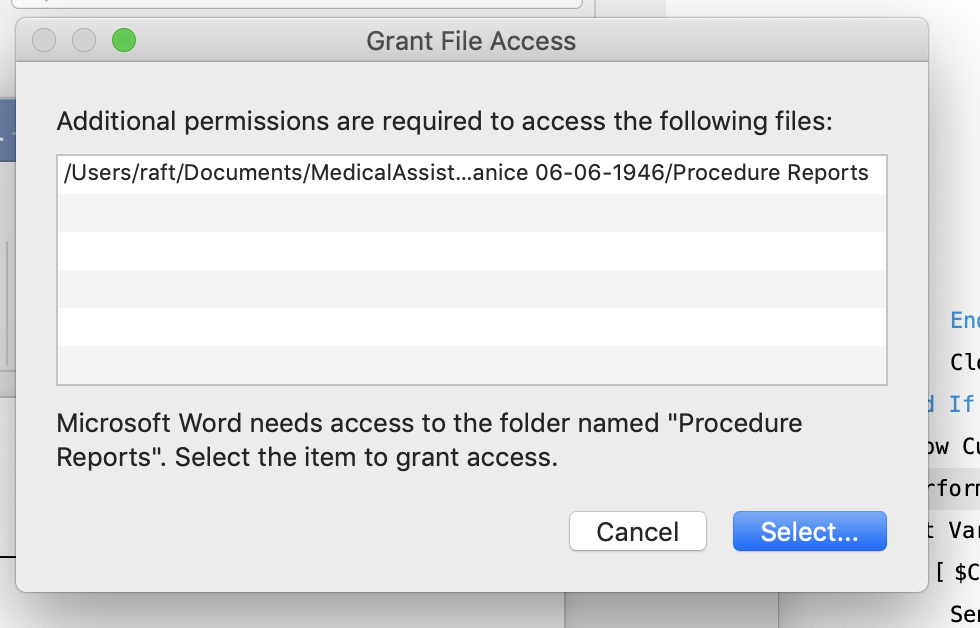
Open File Explorer. Browse and find the file or folder you want to have full access. Right-click it, and select Properties. Click the Security tab to access the NTFS permissions. Click the Advanced button. On the 'Advanced Security Settings' page, you need to click the Change link, in the Owner's field. 7.Click the Advanced button. Grant File Access Microsoft Office 2019. I have been using Office 2011 without issue with Filemaker Pro. When documents are loaded they are done by running an applescript that opens a word document and then converts it to a pdf. Since upgrading to Office 2019, I now get a request to 'Grant File Access'. Once access to the directory is granted, the file open and converts successfully. If you are running both Macs and PCs on your network, there’s a good chance you might want to share files between your Mac and PC. You can do this in one of two directions: either access Mac files from a Windows PC or access Windows files from a Mac. Today I’m going to talk about how you can share files on your Mac and access them on your PC.
If I understand your post correctly, you turned on iCloud drive but then turned it off and now you're unable to open documents that were moved to iCloud Drive. I'll be happy to help with this.
You can visit iCloud.com to access these files. To remove them from iCloud and store them locally, you'll need to set up iCloud again to access the documents stored there. Then you can store the documents locally on your Mac again. This article will tell you more:
Add your Desktop and Documents files to iCloud Drive
Let us know if that resolves this issue for you.
Thanks for using the Apple Support Communities. Have a great day.
- To set permissions, follow these steps: Click the item to select it, press Command+I (or choose Finder→File), and then choose the Get Info menu item. Alternatively, you can right-click the item and choose Get Info instead. Either way, Mac OS X displays the Info dialog. Click the right-facing arrow next to the Sharing & Permissions heading to expand it.
- Start quickly with the most recent versions of Word, Excel, PowerPoint, Outlook, OneNote and OneDrive —combining the familiarity of Office and the unique Mac features you love. Work online or offline, on your own or with others in real time—whatever works for what you’re doing.
Nov 19, 2016 11:58 AM
Problems with Apple’s sandbox requirements in Mac Office 2016 and higher with VBA code
In Windows Excel 97-and higher and in Mac Excel 2011 you can open files or save files where you want in almost every folder on your system without warnings or requests for permission. But in Mac Office 2016 and higher Microsoft have to deal with Apple’s sandbox requirements. When you use VBA in Mac Excel 2016 or higher that Save or Open files you will notice that it is possible that it will ask you permission to access the file or folder (Grant File Access Prompt), this is because of Apple’s sandbox requirements.This means that when you want to save/open files or check if it exists with VBA code the first time you will be prompted to allow access on the first attempt to access such a folder or file.
How to avoid problems
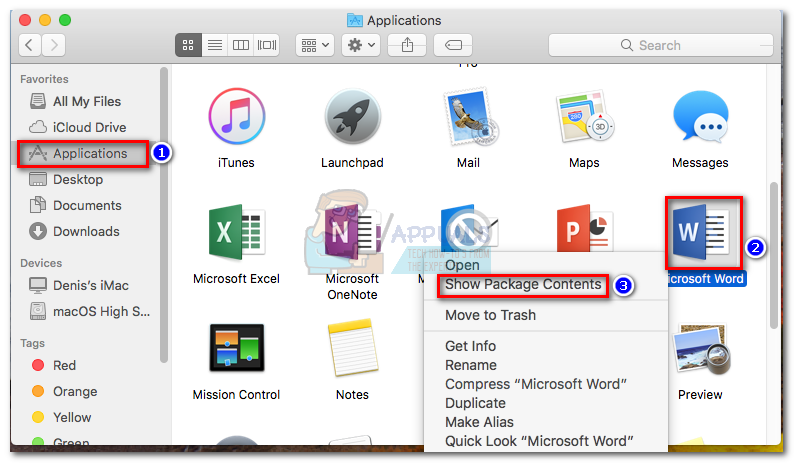
There are a few places on your Mac that you can use to avoid the prompts and let your code do what it needs to do without user interaction. But these folders are not in a place that a user can easily find so below are some steps that I hope to make it easier for you to access the folder manual if you want.
This is the Root folder on my machine that we use in the examples on this page:
/Users/rondebruin/Library/Group Containers/UBF8T346G9.Office
Note: rondebruin is the user name in this path and I agree that the naming of the folder for Office(UBF8T346G9.Office) is not so nice, but Microsoft must use that of Apple.
I not use this location on this example page to be sure that every Office program can access my files if this is needed. To get this Excel path you can also use Environ('HOME')
Grant File Access Word Mac 2019 Crack
or Environ('CFFIXED_USER_HOME')Manual create a folder for your Excel files in the Office folder
- Open a Finder Window
- Hold the Alt key when you press on Go in the Finder menu bar
- Click on Library
- Open the Group Containers folder
- Open the UBF8T346G9.Office folder
- Create a Folder inside this folder named MyExcelFolder for example
- Select this folder
This are three ways to easily open the folder manual :
- Add it to your Favorites in Finder by dragging it to it.
- Add it to your Favorites in Finder with the shortcut : cmd Ctrl T
- Drag the folder to the Desktop with the CMD and Alt key down. You now have a link(alias) to the folder on your desktop so it is easy to find it and open it in the future.
Note : Adding the folder to your Favorites is my favorite because you see the folder in your open and save dialogs in Excel.
Or use this script one time to create a folder for your Office files and create shortcuts to a few important folders, check out this page : Setup your Mac for Mac Office 2016 or higher
How to create a Folder in the Office folder with VBA code
Below you find a macro and a function that you can use to create a folder if it not exists in the Root folder named : UBF8T346G9.Office
In the macro you see one line that call the function and the argument is the name of the folder that you want to create if it not exists. Change 'MyProject' to something else to create another folder.
How do I open files with VBA code in my folder ?
Below you find a macro and a function that you can use to open a file in one of the sub folders of the UBF8T346G9.Office folder. In the macro you see one line that call the function and there are two arguments :
- Name of the sub folder
- Name of the file
Note : You can also add code in the macro to test if the file is already open, I use that also in the code example in this section : Browse to a file or files in a sub folder of the Office folder.
How do I Save a file with VBA code in my folder ?
The first macro create a file of only the activesheet and save it in a folder named: ProjectName and the second macro save a copy of the file in a folder named Backup. Both are sub folders of your UBF8T346G9.Office folder. Be sure you update your Mac Office install so it is 16.9 or higher.
Note : Both macros use the custum function CreateFolderinMacOffice that you find in the first section of this page.
Browse to a file or files in a sub folder of the Office folder

Ms Word For Mac 2019
In the example below it opens a browse dialog with a folder folder named : MyExcelFolder from your UBF8T346G9.Office folderand you are only able to select xlsx files. Below the macro you find a list of format names and you can read how you can change it. Note: Do not forget to copy the bIsBookOpen function in your module, you find it below the macro.
Other file formats :
In the macro you see this code line that say which file format you can select (xlsx).
FileFormat = '{'org.openxmlformats.spreadsheetml.sheet'}'
If you want more then one format you can use this to be able to also select xls files.
FileFormat = '{'org.openxmlformats.spreadsheetml.sheet','com.microsoft.Excel.xls'}'
This is a list of a few formats that you can use :
xls : com.microsoft.Excel.xls
xlsx : org.openxmlformats.spreadsheetml.sheet
xlsm : org.openxmlformats.spreadsheetml.sheet.macroenabled
xlsb : com.microsoft.Excel.sheet.binary.macroenabled
csv : public.comma-separated-values-text
doc : com.microsoft.word.doc
docx : org.openxmlformats.wordprocessingml.document
docm : org.openxmlformats.wordprocessingml.document.macroenabled
ppt : com.microsoft.powerpoint.ppt
pptx : org.openxmlformats.presentationml.presentation
pptm : org.openxmlformats.presentationml.presentation.macroenabled
txt : public.plain-text
More information
See this page for more information about selecting files in Excel 2011 and Excel 2016 and higher
See this page for more information about the file format numbers
FileFormat numbers in Mac ExcelGrant File Access Word Mac